Top Signs You Need Garage Door Service – Don’t Ignore These
If your opener has started straining on the way up but the door snaps down fast, your first instinct is probably to blame the motor. In our experience, that symptom almost always points to a spring that’s lost a good chunk of its tension and doesn’t have much time left. The signs that matter most are mechanical tells, not the obvious “it’s loud” complaints. Read them right and you catch a small problem early. Read them wrong and you turn a modest repair into a much bigger one. If you’d rather not play detective yourself, call (855) 337-1105 and we’ll take a look.
Why the Obvious Signs Are Usually the Wrong Ones
Most homeowners diagnose a garage door by ear and by gut, and both tend to point at the wrong part. A door that hesitates on the way up gets blamed on the opener. A door that shudders gets blamed on the cold. A door that feels a little heavy gets a squirt of lubricant and a shrug. Garages in Zionsville sit through humid summers and freeze-and-thaw winters, and that cycle works on springs, cables, rollers and hinges every single year. The metal doesn’t complain loudly until something is close to failing.
The gap between early and late repair is real, and it’s the whole reason this post exists. A worn roller or a loose track bolt is a quick fix. A snapped torsion spring or a cable that’s jumped its drum is a bigger job, and it usually arrives with a door stuck open or shut. Learning to read the actual mechanical signals is how you stay on the cheap side of that line.
Here’s what we look for, and what we’d tell any Zionsville homeowner to watch for between professional visits.
The Asymmetry Test: Spotting a Failing Spring Before It Snaps
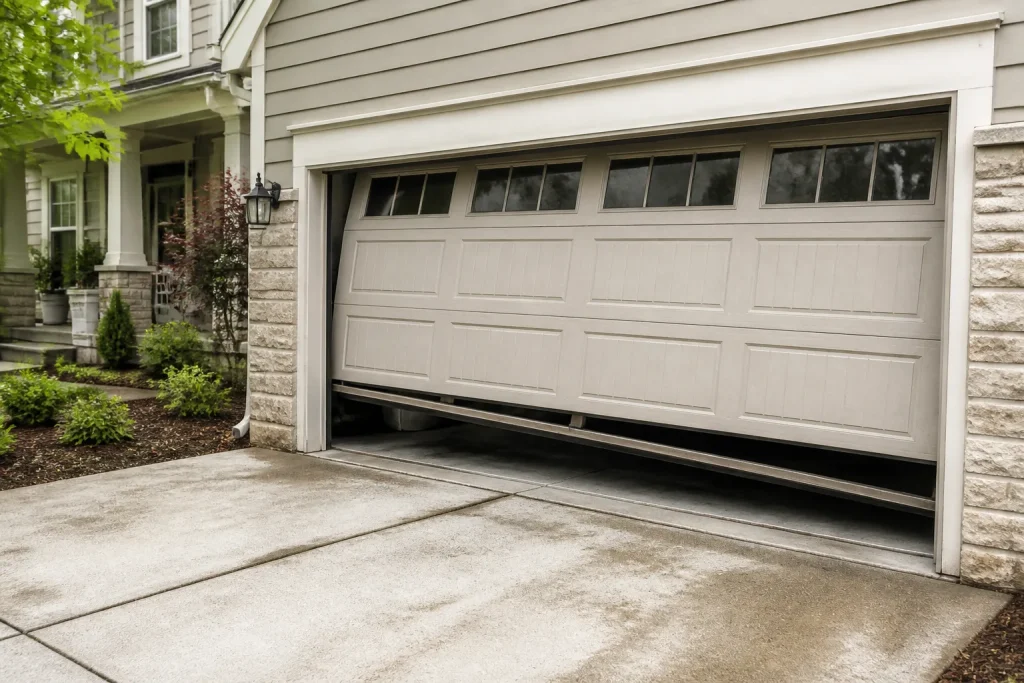
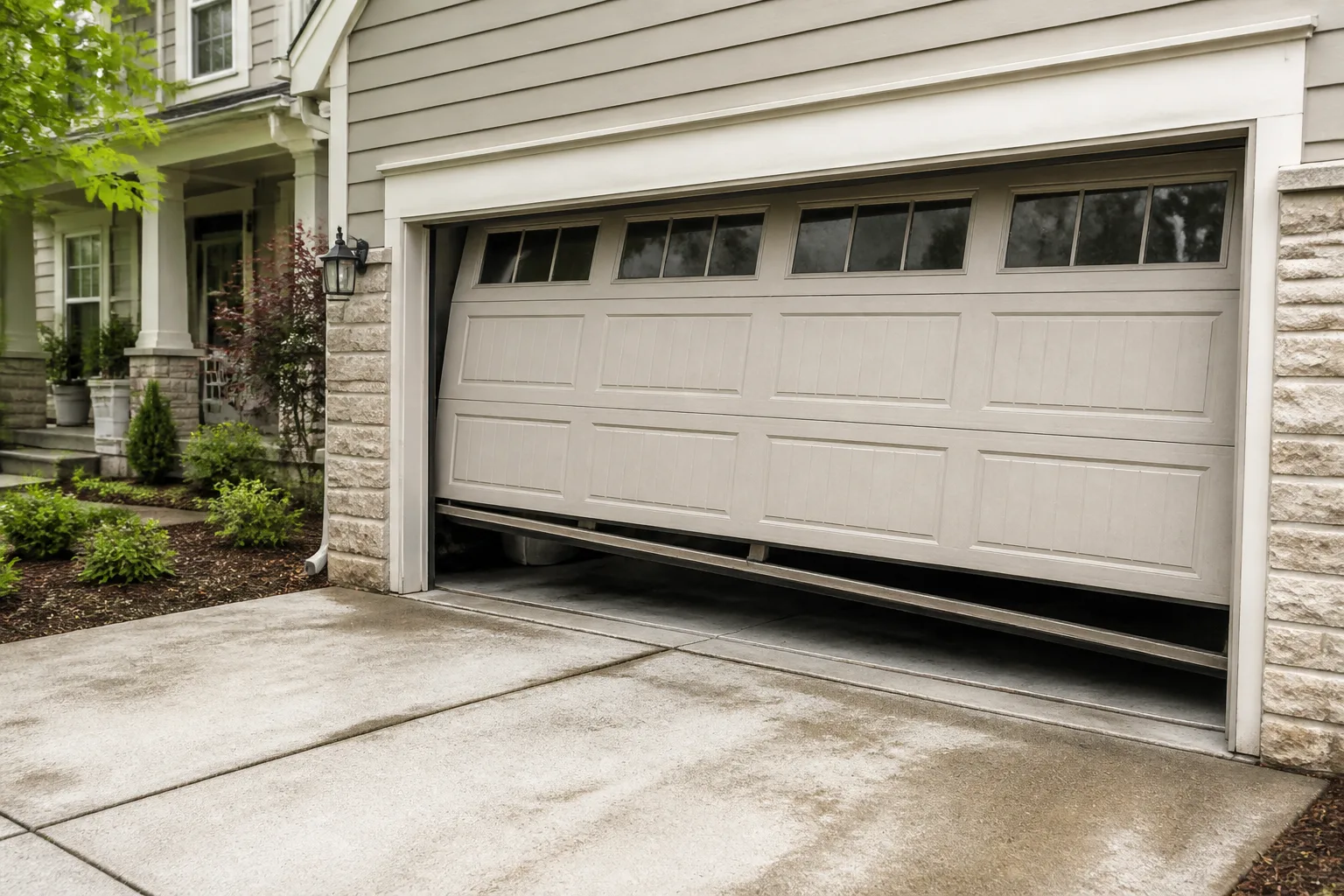
A healthy garage door lifts evenly, both sides rising and falling together. A failing spring breaks that symmetry, and you can see it before you ever hear it.
Stand inside the garage, off to one side, and watch the gap between the top of the door and the header as it opens. Then watch the bottom edge against the floor. On a torsion-spring setup, the door should lift level. If one side lags, or the door tilts slightly as it rises and straightens out near the top, that’s a spring that’s no longer carrying its share of the load. On extension-spring doors, look at the springs themselves – if one looks stretched longer than the other, it’s holding less tension than its partner.
Springs are wound steel under serious load, and they fail without warning. Do not adjust, wind, unwind or remove one yourself. That’s a job for a technician who knows the torsion math and has the winding bars to do it safely. We handle garage door spring repair as its own dedicated service for exactly that reason, because it’s the most mechanically dangerous part of the whole system.
What Intermittent Sensor Errors Really Mean on a LiftMaster or Chamberlain
Your opener flashes, the door reverses for no reason, or the wall button works but the remote doesn’t. If your first move is to check whether the safety sensors are pointed at each other and they look fine, the problem usually isn’t the sensor at all.
On LiftMaster and Chamberlain systems in particular, intermittent “sensor” behavior frequently traces to the logic board or the wiring run to the sensors, not the sensors themselves. Sunlight hitting one eye, a wire that’s been nicked by a lawn tool, or a board that’s lost a channel can all mimic a sensor fault. Genie and Craftsman openers throw their own versions of the same confusion. This is the sort of thing that rewards a proper diagnostic instead of parts-swapping.
- Sensor LEDs flicker or stay dark on one side only: often wiring or board, not the sensor.
- Works from the wall button but not the remote: usually a receiver or logic board issue.
- Door reverses at the same spot every time: check for a physical obstruction, then suspect the travel limits or the board.
- Random behavior that comes and goes: wiring, moisture, or a board on its way out.
If your opener is doing any of this, it’s worth a look before it strands you. That’s a natural fit for garage door opener repair, and we work on the brand you already have – LiftMaster, Chamberlain, Genie, Craftsman and more – so there’s no need to start over with new equipment.
Sound Profiles: What Each Noise Is Trying to Tell You
Garage door noises aren’t interchangeable. Each one maps to a specific part, and learning to tell them apart saves you a diagnostic fee and a headache.
Grinding, high-pitched and rhythmic as the door moves usually means a worn roller or a dry hinge. Rollers wear flat spots and start dragging against the track. It’s a cheap fix and a good one to catch early, because a seized roller will chew up the track over time.
Popping or clanking, especially when the door first starts moving, often points to a loose track bolt or a hinge that’s working itself free. You can sometimes see the vibration in the track itself.
Creaking or groaning is frequently a lubrication issue on hinges and rollers, or a torsion spring that’s lost tension and is working harder than it should.
A loud bang from the garage, followed by a door that won’t open or a car that can’t get out, is usually a spring letting go. That’s urgent and it’s not a DIY fix.
Most of these are easy to sort out. When the door won’t move at all, we treat it as emergency service, because a stuck door is often a security problem as much as a mechanical one.
Why a Door That “Looks Fine But Feels Heavy” Is Urgent
A garage door should lift with one hand and stay put when you let go halfway up. If you disconnect the opener, lift the door by hand and it feels like you’re dragging it, or it slams back down, that’s a spring problem – not a lubrication problem. No amount of oiling will fix it.
A door that’s lost spring tension is putting the full weight of the door on the opener motor and the cables. The motor will strain, the cables take a load they weren’t designed for, and the whole system moves closer to failure every time it cycles. This is the single most common misread we see in Zionsville: a homeowner oils the tracks, the door still feels heavy, and three weeks later the spring goes. If it feels heavy by hand, stop using it and get it checked.
The 10-Second Driveway Check That Reveals Cable Wear
Before you pull out, look up at the cables running vertically along each side of the door, and at the drums at the top. This takes about ten seconds and it’s the single best early-warning check you can do.
- Fraying or broken strands: any bird-caging or separated wire means the cable is compromised.
- Slack or a cable off its drum: a cable that’s jumped the drum or gone loose is a serious hazard.
- Rust or kinks: rust streaks and sharp bends weaken the cable over time.
- Uneven tension: one cable noticeably tighter or looser than the other points to a drum or spring issue.
Cables are under extreme tension, and a snapped cable can whip with enough force to injure someone. If you see any of the above, don’t touch it – call a pro. That visual check is the cheapest insurance you’ve got, and it’s one we recommend every Zionsville homeowner make a habit.
When to Call a Pro
Some signs you can note and keep an eye on. Others mean stop and call. Springs, cables, and anything that involves the torsion system under load are firmly in the second category – the risk of injury isn’t worth the saved call. If your door feels heavy, lifts unevenly, or has gone down for the count, that’s your cue. We’re a garage door specialist and nothing else: springs, openers, panels and full replacements, all under one roof, on the brand you already have. If the door won’t move and you’re stuck, our emergency service exists for exactly that moment. Reach out any time and we’ll get you scheduled – call (855) 337-1105 for a free estimate.
The Bottom Line
Catch the right sign and you pay for a small fix. Misread it and you pay for a bigger one. Watch for asymmetry during operation, take the ten-second cable look from the driveway, and treat a heavy-feeling door as an urgent spring issue rather than a lubrication problem. Those three habits cover most of what goes wrong. We work on Clopay, Amarr, Wayne Dalton and Craftsman doors alongside the rest, so whatever you’ve got, we’ve seen it before. If you’re in Zionsville and need help, Zionsville Garage Door Repair Pros offers free estimates – call (855) 337-1105.
Related services in Zionsville: garage door repair and garage door spring repair, and for the bigger picture, the Zionsville Garage Door Repair Pros homepage.
Frequently Asked Questions
The earliest reliable signs are a door that lifts unevenly, one side lagging behind the other, a door that feels heavy when you lift it by hand, and grinding or popping noises as it moves. Any of these point to a specific worn part and are worth a look before they get worse. Call (855) 337-1105 if you’re not sure what you’re hearing.
A spring on its way out usually shows up as a door that lifts crooked, snaps down too fast, or feels heavy by hand. On extension-spring doors, one spring often looks more stretched than the other. When those signs appear, stop using the door and have it checked – springs are under extreme tension and should never be adjusted by a homeowner. Call (855) 337-1105 for a free estimate.
When the sensors look aligned but the error keeps returning, the cause is often the logic board or the wiring to the sensors rather than the sensors themselves. Sunlight, a nicked wire or an aging board can all mimic a sensor fault. A proper diagnostic is the fastest way to know. Call (855) 337-1105 to get it looked at.
No – a door that feels heavy by hand is almost always a spring that’s lost tension, not a lubrication problem. Oiling the tracks won’t restore the lift force. Using the door in that state strains the opener and cables and pushes the whole system toward failure. Call (855) 337-1105 for an honest assessment before it gets worse.
Written by the team at Zionsville Garage Door Repair Pros.
Need Garage Door Help?
Call Zionsville Garage Door Repair Pros - the local pro we connect you with is licensed and insured, here with fast after-hours help in Zionsville.
(855) 337-1105