Garage Door Repair: Repair or Replace? How Zionsville Homeowners Decide
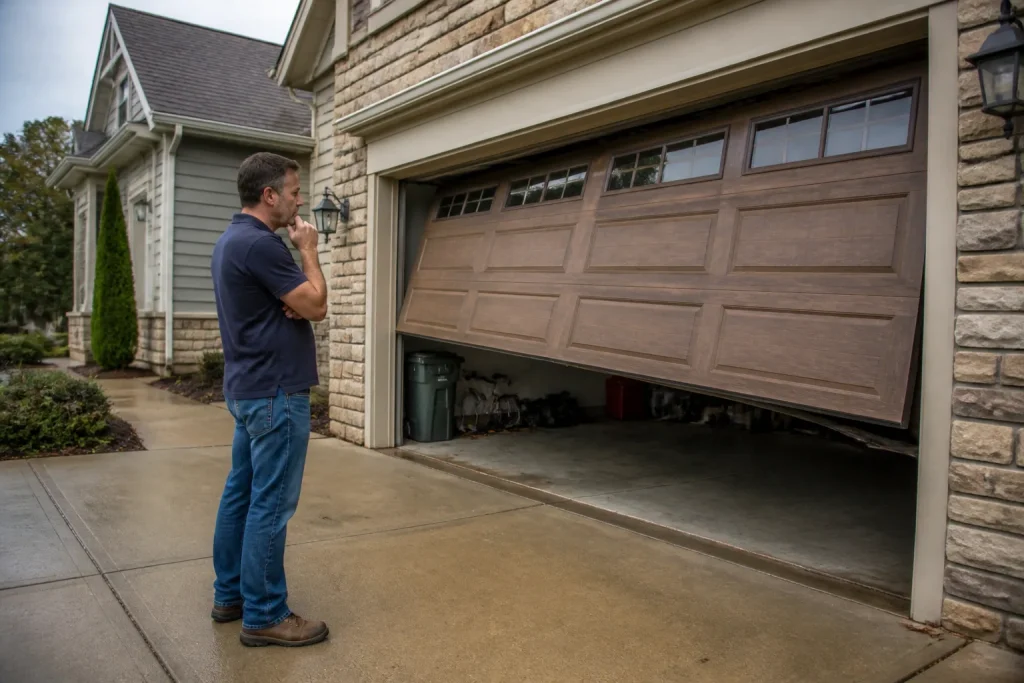
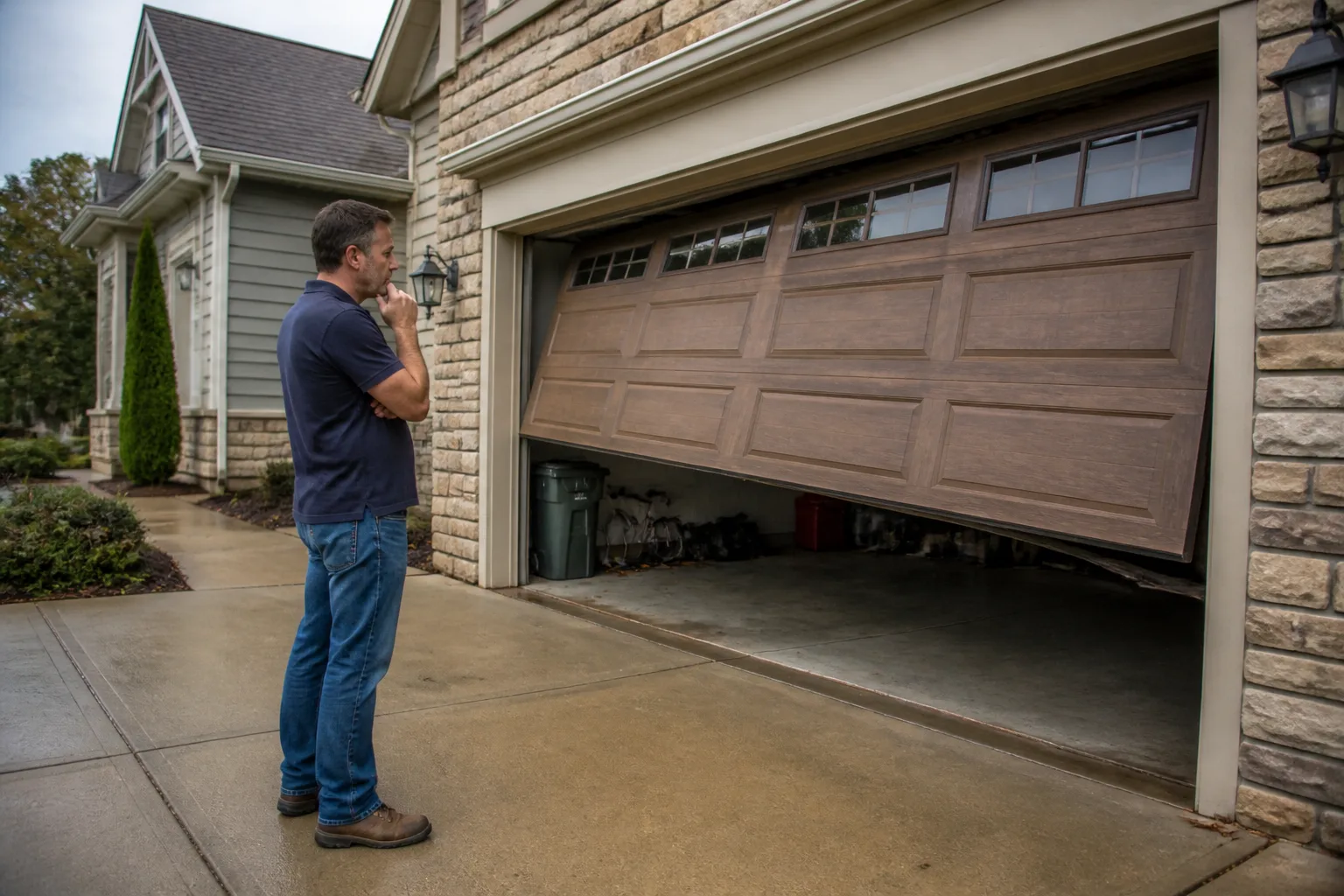
A contractor who leads with “at this age, I’d just replace it” without mentioning panel availability, spring cycle count, or track gauge is telling you more about their margin than your door’s condition. The repair-or-replace question gets answered that way too often in Zionsville: fast, confident, and missing the reasoning. Here’s the short version. If the door’s structure is sound, the panels are still manufactured, and the opener matches the door’s weight, repair usually wins. If any of those three fails, replacement often makes better financial sense. If you’d rather skip the detective work, call (855) 337-1105 and we’ll walk through it with you.
Is It Better to Repair or Replace a Garage Door in Zionsville?
Repair is usually the better call when the door is structurally sound and the damaged parts are still made for your model. Replacement wins when panels are discontinued, when rust or rot has spread through the frame, or when repair costs climb past roughly half of what a new door would run. That’s the whole decision in two sentences, and it holds for most Zionsville homes.
What makes it feel complicated is that the three factors that actually drive the answer don’t get equal airtime. Here’s the framework we use:
- Door age relative to spring cycle life. Springs are rated in cycles, not years. A standard torsion spring is typically rated around 10,000 cycles. A door that opens and closes four times a day burns through that in about seven years. A door used twice a day stretches the same spring further. So a twelve-year-old door with light use might have springs with life left, while a six-year-old door on a busy household might already be on borrowed time.
- Where the panel damage sits. The bottom panel takes the abuse: errant bumpers, winter ice, kids’ bikes. The top panels mostly just sit there. That distinction matters enormously for cost.
- Opener compatibility with current door weight. Swapping a steel door for an insulated one adds weight. An older opener sized for the original door may strain, and a LiftMaster or Chamberlain unit has to be matched to what it’s actually lifting.
Get clear answers on all three before anyone quotes you a number. That’s the honest order of operations.
Why Panel Availability Is the Factor Everyone Misreads
Panel damage is the most misread factor in the repair-or-replace decision, and it isn’t close. The location of the damage and whether that panel is still in production determine everything. A single bent bottom panel on a Clopay 4300 is typically a $200-ish fix, because that panel is still manufactured and swaps out cleanly. The same damage on a discontinued Wayne Dalton model can force a full replacement, because you can’t buy the panel.
So the real question isn’t “how bad is the dent?” It’s “can I still get this panel?” That’s why a contractor who quotes replacement before checking panel availability is either guessing or selling. In our experience, the check takes a phone call or two and settles the whole question.
A few things worth knowing about panel damage specifically:
- Bottom panels are replaceable in most current models. Clopay, Amarr, and comparable lines still stock common profiles.
- Discontinued lines are the trap. Older Wayne Dalton and off-brand doors often have no replacement path.
- Damage above the bottom panel is rarer but costlier to source. Those panels see less wear, so fewer spares circulate.
- Cosmetic dents aren’t structural. A dent that doesn’t affect the seal or the panel’s straightness is a paint-and-move-on situation.
If panel damage is the whole problem, a straightforward garage door repair usually closes the case. If the panel’s gone from production, replacement enters the conversation honestly.
The 50% Rule: The Actual Math Zionsville Homeowners Should Run
The 50% threshold is the shorthand: if a repair costs more than half of what a new door would cost, replacement usually wins. What people get wrong is using yesterday’s numbers for replacement. Here’s how to run it against real Zionsville installation cost ranges.
| Item | Typical Zionsville range |
|---|---|
| Single-spring repair (one spring) | $180 – $340 |
| Matched spring pair (usually replaced together, so about twice one spring) | $360 – $680 |
| Opener repair or replacement (unit-dependent) | $150 – $450 |
| Bottom panel replacement (current model) | $200 – $400 |
| Full single-car door installation | $900 – $2,500 |
| Full double-car door installation | $1,800 – $4,500 |
Now the math. If your repair quote lands at $600 and your replacement would be $2,000, that’s 30% of replacement value. Repair. If the quote is $1,300 against a $2,000 replacement, you’re at 65% and looking at a new door. The line sits near 50%.
Two caveats. First, a matched pair of springs runs about twice a single spring, so don’t compare a one-spring quote to a two-spring job. Second, these are typical ranges, not fixed prices. The written estimate sets the final number, and we quote it before any work starts so there are no surprises on the invoice.
When the springs are the problem, honest spring work is its own specialty. garage door spring repair is the piece of this trade that causes the most injuries among people who try it themselves.
How Zionsville Home Context Shifts the Math
Zionsville homes have a specific curb-appeal calculus that most repair-or-replace guides ignore. A garage door is one of the largest visible surfaces on a house. In neighborhoods like Heritage Park and Creekside, where HOA guidelines shape exterior appearance and homes sit close to the street, a door in visible decline affects how the house reads long before it stops working.
That context can legitimately push the math toward replacement even when repair is mechanically fine. If the door is fifteen years old, the panels are discontinued, and the finish has gone chalky, spending $350 to fix a cosmetic ding on a door that’s heading for replacement anyway is money down the drain. Meanwhile, a mechanically sound door with current panels and decent finish is a repair candidate every time, curb appeal notwithstanding.
The flip side matters too. A door that’s structurally solid and weather-sealed tightly is doing its job in an Indiana climate that swings from humid summers to hard freezes. Cold snaps stress springs, ice builds along the bottom seal, and a door that isn’t sealing costs you on heating. Functional beats pretty when the functional side is failing.
A quick way to sort it:
- Repair bias: current-model panels available, springs within rating, opener matched to door weight, finish intact.
- Replace bias: discontinued panels, springs near or past cycle rating, opener straining against a heavier door, finish failing, HOA or street-facing aesthetics mattering to resale.
- Judgment call: repair cost sitting between 40% and 60% of replacement. Run the numbers, then decide.
What an Honest Recommendation Sounds Like
An honest recommendation names the factors. A sales-driven one skips them. That’s the cleanest test you can apply when a technician is standing in your driveway.
Here’s what trustworthy advice sounds like in practice:
- “Your bottom panel is still in production for this Clopay line, so we can swap it.” Specific about the part, the model, and the reason.
- “Your springs are past their rated cycles. A matched pair makes sense.” References the cycle count, not just the calendar.
- “Your opener is fine for this door, but if you go heavier, it’ll need to be checked.” Flags compatibility before it becomes a problem.
- “I’d run the 50% math with you before we go either way.” The estimate comes with the reasoning attached.
- “The panel’s discontinued, so repair means a mismatched look or a full replacement.” States the tradeoff plainly instead of recommending the bigger job first.
What sales-driven language sounds like: “at this age, I’d just replace it,” with no mention of panel availability, spring cycles, or track gauge. If the age of the door is the only reason given, ask three follow-ups. What’s the spring cycle rating? Is the panel still manufactured? Does the opener match the door weight? A technician with real answers can give them on the spot.
One more thing: verify the opener side of the equation. As doors age, the opener takes more strain, and an older unit can fail while the door itself is fine. That’s a separate repair, not a door replacement, and it’s worth knowing which problem you actually have. If the opener is the issue, garage door opener repair is the right call, and our technicians work on the brand you already have, whether that’s LiftMaster, Chamberlain, Genie, or one of the other lines we service.
When to Call a Pro
Some parts of this decision you can evaluate yourself: pulling the 50% math, checking whether the weather seal closes evenly, noting whether the door opens smoothly or jerks. What you shouldn’t handle yourself is anything involving torsion springs, cables, or the opener’s electrical connection. Those springs sit under serious tension, and improper handling can cause severe injury. That’s not a warning to ignore. It’s the reason spring work is a trained technician’s job, and it’s why we treat it as a dedicated service rather than a side note.
If the door won’t move at all or it’s stuck halfway and holding your car hostage, emergency service is available for exactly that kind of situation.
Related services in Zionsville: Zionsville Garage Door Repair Pros covers the full scope, including garage door opener repair and full installation. Every estimate is free and quoted before work starts.
The Bottom Line
Run the framework before anyone quotes you a number:
- Spring cycles over calendar years. Springs are rated in cycles, not age. Ask for the cycle rating.
- Panel availability decides the panel question. A current-model bottom panel is a modest fix; a discontinued panel can force full replacement.
- Match the opener to the door. Weight changes affect what the opener can safely lift.
- Run the 50% math against real Zionsville installation ranges. A single spring is $180 – $340, a matched pair about twice that, and full installation runs $900 – $2,500 for a single door and $1,800 – $4,500 for a double.
- Get the reasoning, not just the verdict. If age is the only argument for replacement, ask the three follow-ups.
The written estimate sets the final price, and we quote it before any work begins. If you’re in Zionsville and need help, Zionsville Garage Door Repair Pros offers free estimates. Call (855) 337-1105 and we’ll walk through the three factors with you, no pressure either way.
Frequently Asked Questions
Repair is almost always cheaper in the short term. A single spring runs $180 – $340 and a current-model bottom panel $200 – $400, against $900 – $2,500 for a full single-door installation. Replacement only wins the long game when panels are discontinued or cumulative repair costs approach half the replacement value. Call (855) 337-1105 for an exact quote, estimates are free.
There’s no fixed age cutoff. The factors that matter are spring cycle count, whether replacement panels are still manufactured for your model, and whether your opener matches the door’s weight. A well-maintained twelve-year-old door with current panels can outlast a newer discontinued model. Age alone is never a reason to replace.
Usually yes, if the panel is still in production. On a Clopay 4300, a bent bottom panel is typically a modest repair. On a discontinued Wayne Dalton model, the panel may not exist anymore, and replacement of the whole door sometimes becomes the only option. Check panel availability before anything else.
No. We quote the price and you agree to it before any work starts. The written estimate is the number you pay, and if we find something different on inspection, we talk it through with you before proceeding. Call (855) 337-1105 to schedule a free estimate.
Written by the team at Zionsville Garage Door Repair Pros.
Need Garage Door Help?
Call Zionsville Garage Door Repair Pros - the local pro we connect you with is licensed and insured, here with fast after-hours help in Zionsville.
(855) 337-1105